
The pharmacist says to keep the insulin cold. The airline says you need a letter for the needles. The security queue says anything over 100ml goes in a clear bag. By the time a diabetic traveller has navigated all three for the first time, they've usually either missed a flight or left something critical in the tray.
Travelling with a medical condition is manageable — millions of people do it every year, without incident, on every kind of route. But it requires a different kind of preparation than a standard trip. The rules around medical clearance, equipment, medication, and insurance each follow their own logic, and getting any of them wrong at the airport costs time, stress, and sometimes money that can't be recovered.
When the airline needs to know before you fly
Not every medical condition needs to be disclosed to an airline. Controlled high blood pressure, mild asthma managed with an inhaler, hay fever, a healed fracture — none of these normally require medical clearance. What airlines want to know about is anything that might affect flight safety or require specific resources during the flight.
The formal process is called a MEDIF (Medical Information Form), and most carriers require it for passengers who:
- Need portable oxygen or medical oxygen on board
- Have had surgery within the past 10–14 days (the window varies by airline and procedure type)
- Were hospitalised or had a significant medical event within the previous four weeks
- Have a condition affecting their ability to sit upright or self-evacuate the aircraft in an emergency
- Have a condition that may deteriorate at altitude — cabin pressure is typically maintained at the equivalent of 6,000–8,000 feet, which reduces available oxygen by around 20%
If you fall into any of those categories, contact the airline's special assistance or medical clearance team — not the standard booking line — well in advance. Most carriers ask for at least 48–72 hours' notice; for complex cases involving medical equipment or stretcher accommodation, several weeks is more realistic. Leaving it to the day of travel risks being denied boarding.
Special assistance and equipment on board
Special assistance at the airport — wheelchair provision, priority boarding, help through security — is a separate request from medical clearance. It can be added at booking on most airlines' websites or by calling the assistance team. Under the framework implementing EU Regulation 1107/2006 (retained in UK law post-Brexit), airports and airlines are required to provide this at no charge to passengers who request it.
For medical equipment on board, the key distinction is powered versus non-powered:
- Non-powered equipment — CPAP machines, nebulisers, splints, manual wheelchairs — is generally permitted in the cabin as a medical exemption and typically does not count against your hand luggage allowance. Carry documentation confirming it's medically necessary.
- Portable oxygen concentrators require specific airline approval before travel. Most carriers stopped carrying medical oxygen for passengers years ago. You must supply the device yourself, and it must appear on the airline's approved list — not all devices are accepted on all aircraft. Allow several weeks for this process.
- Prosthetics and mobility aids are subject to separate rules: most airlines transport them free of charge in the hold, and security staff are trained to handle them during screening.
Medications in the cabin
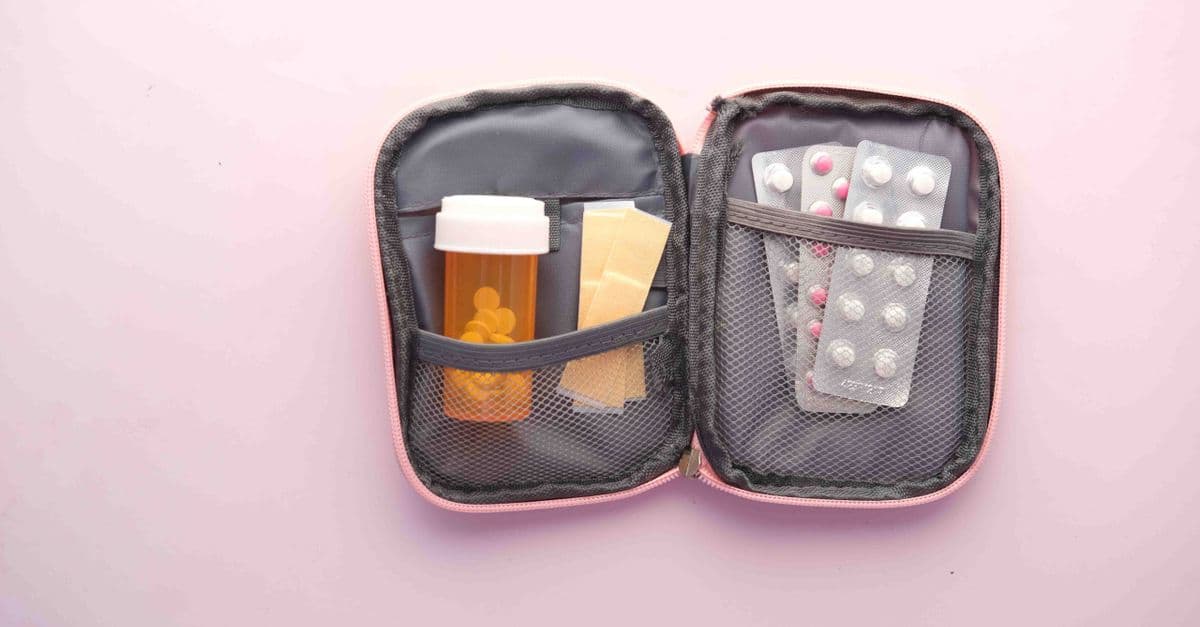
The rule is straightforward: all medication goes in the cabin with you. Never in checked baggage. Bags get lost, delayed, and left sitting in unheated or overheated holds; a missing bag is an inconvenience for most passengers and a genuine emergency for someone who needs insulin, anticoagulants, or anticonvulsants.
Liquid medication rules are where the confusion usually starts. The 100ml restriction has a medical exemption: prescription liquids — insulin, liquid antihistamines, eye drops, suspensions — can be carried in quantities over 100ml when you have evidence of medical need. At most UK and European airports, a sealed pharmacy box with your name on the label is sufficient. For destinations outside Europe, a signed letter from your GP is the safer option.
For controlled drugs — opioids, some benzodiazepines, ADHD medications — the requirements are more specific:
- Carry them in original packaging with the pharmacy label intact
- Carry a letter from the prescribing doctor on headed paper, listing the drugs, quantities, and your diagnosis
- For trips of over three months, or to countries with strict import controls — Japan, Indonesia, the UAE, and several others are common examples — you may need a Home Office licence or an import permit from the destination country's authority
- Some medications legal in the UK are classified as controlled or prohibited in other countries; check the FCDO country-specific advice before travel, not after
For insulin and refrigerated medications: most airlines will not keep insulin cold during the flight, and in most cases that's fine — insulin is stable at room temperature below 25°C for 28 days once opened. The risk point is transit through airports in summer heat. An insulated medication wallet with an ice pack handles this within the liquid rules, since the medication itself is what's regulated, not the insulation.
Use our packing list tool to build a cabin-ready medication kit — it lets you flag medical items separately from standard luggage and check them against cabin restrictions.
The GP letter — what it should say
A travel letter from your GP is not a formal prescription, and GPs are not required to provide them under NHS terms of service — expect a small admin charge (typically £15–£30). It should be on headed paper, signed, dated, and include:
- Your full name and date of birth
- The condition or conditions you're travelling with
- The medications prescribed, their dosages, and a brief statement that they're medically necessary
- Any equipment you're carrying and why (“requires CPAP machine for diagnosed obstructive sleep apnoea”)
- A note that quantities are for personal use during the period of travel
Keep both digital and paper copies. One goes in your carry-on, one in your checked bag (so that if your carry-on is somehow misdirected, you can still prove the medication is yours), and one in your email inbox for access from your phone. If you're travelling to a destination where English isn't widely spoken in hospitals, consider having a medical summary translated in advance — several apps and insurers' assistance teams provide this as a service.
Travel insurance for pre-existing conditions
This is where more claims fail than anywhere else. The rule is simple but non-negotiable: declare everything. Every condition, every medication, every device. If you don't declare a pre-existing condition and you make a claim, insurers can void the entire medical section of the policy — not just the claim related to the undeclared condition. The insurance was technically valid; it just didn't cover what happened.
Our post on how travel insurance actually works covers the mechanics in detail, but the key point for travellers with medical histories is where to buy. Standard comparison sites are not designed for complex health screenings — they ask a few questions, assign a loading or an exclusion, and move on. Specialist insurers — Staysure, AllClear, Free Spirit — have granular screening processes built around the actual medical picture and will provide cover where a standard policy either declines or excludes the most likely claims.
When comparing policies, look specifically at:
- Whether emergency medical repatriation is included — this is essential for conditions that could deteriorate and require specialist care back home
- How the policy defines “pre-existing condition” — some use a two-year look-back, others five years, others “ever diagnosed”
- Whether deterioration of an existing condition mid-trip is covered under the emergency medical section or explicitly excluded
- The emergency assistance phone number — call it before you seek treatment abroad, not after
The Global Health Insurance Card
UK residents can apply free for a GHIC (Global Health Insurance Card, the post-Brexit successor to the EHIC), which gives access to state healthcare in EU countries at the same rates as a local resident. It's useful for managing a known condition mid-trip — a repeat prescription, a routine monitoring check — but it does not replace travel insurance. It doesn't cover repatriation, private hospitals, or anything outside the EU. Apply at nhs.uk.
Timing medication across time zones
For medications that must be taken at specific biological intervals — insulin, anticonvulsants, some cardiac drugs — crossing multiple time zones requires a plan. Shift the dose time gradually in the days before departure, or keep dosing on home time for short trips and adjust gradually on arrival. Your prescribing doctor or pharmacist is the right person to advise on the specific drug; the general principle is that consistency of interval matters more than consistency of clock time for most medications.
The timezone converter makes it easy to map home medication times to local equivalents — useful for building a written schedule to follow on a long-haul trip where local time shifts by five or more hours.
At your destination
Pack enough medication for the full trip plus a buffer — a standard guideline is the actual quantity needed plus 50% extra, stored separately from the main supply (one week's emergency supply in a different bag, for example). Original packaging travels more smoothly than pill organisers when going through customs in countries with strict drug import rules.
For serious conditions — severe allergies with anaphylaxis risk, insulin-dependent diabetes, epilepsy — a medical alert bracelet or card in the local language can communicate critical information when the wearer cannot. Several services produce these in multiple languages. Your insurer's assistance team can also help with local-language medical summaries for destinations where your condition name may not translate directly.
If something goes wrong at your destination, the first call is to your insurer's 24/7 emergency assistance line — the number is on the policy document, not a general customer service line. They can direct you to an approved local facility, arrange direct billing so you don't have to pay upfront, and advise on whether the situation warrants repatriation. Seeking treatment first and notifying the insurer later is the most common reason otherwise valid medical claims are disputed.